
Recognizing dangerous goods before they enter the supply chain
On 9 October 2026 countries around the world celebrate World Post Day. This year’s theme is:
❝ One postal network, infinite possibilities.❞
A nice slogan, right? And a relevant one, as it highlights the role of the global postal network in connecting people, businesses and communities around the world.
Sending a letter or parcel today may seem like an everyday activity. Behind each international postal item is, however, a network of postal operators, customs authorities, airlines and other organizations working together to move it safely to its destination.
This international cooperation dates back more than 150 years. On 9 October 1874, representatives of 22 countries signed the Treaty of Bern, establishing what was then known as the General Postal Union. The treaty simplified the complex system of bilateral postal agreements by creating a single postal territory for the exchange of international mail. In 1878, as its membership rapidly expanded, the organization was renamed the Universal Postal Union (UPU). In 1948, the UPU became a specialized agency of the United Nations.
In 1969, the UPU Congress in Tokyo declared 9 October as World Post Day. Since then the day has been used to raise awareness of the role of postal services in the everyday lives of people and their contribution to social and economic development.

If you think about it, it is a massive operation: hundreds of thousands of post offices and millions of postal workers around the world work together to keep letters and parcels moving. Quite an impressive achievement.
Everyday items can be dangerous goods
As you can imagine millions of letters and packages are sent by people and companies all over the world and for most people sending a parcel starts with something simple. A gift is placed in a box, an address is added and the package begins its journey to a friend, customer or family member.
The Universal Postal Union specifically warns about many everyday items that can be considered dangerous goods, including lithium batteries found in children’s toys or earbuds, cleaning products and perfume. Or did you know about medicine that is packed with dry ice or alcohol? Some of these are chemical products that people and businesses work with every day, often without immediately thinking of them in the context of dangerous goods.
On their own and in small quantities, you might wonder: why are these products dangerous? The situation changes when they are prepared for transport, particularly when specific transport conditions or restrictions apply. This is why seemingly ordinary products can be subject to specific requirements during transport.
Dangerous goods are generally prohibited from international mail with some exceptions for certain items. (For example, some postal operators can accept equipment containing lithium batteries when the applicable requirements are met.) But those that are prohibited or incorrectly prepared should ideally be identified before they enter the postal and aviation network in the first place.
IATA's concern
And this remains an important concern within international transport. Because during transport a parcel may become part of an air cargo operation.
On September 24, 2026, the International Air Transport Association (IATA) called for stronger action across the air cargo supply chain to address undeclared and mis-declared dangerous goods.
According to IATA, approximately 80% of dangerous goods incidents reported to IATA during the first half of 2025 involved undeclared or hidden dangerous goods. Among the products commonly identified were lithium batteries, perfumes and aerosols, such as deodorant and hairspray.
The IATA white paper also highlights examples of incorrectly declared chemical products, including flammable paint shipped as ordinary samples and corrosive liquids declared under incorrect UN numbers. Among the possible causes of mis-declaration, IATA identifies incorrect classification, insufficient training and outdated or improperly prepared Safety Data Sheets (SDS).
IATA also emphasized that cargo security screening alone cannot solve this problem. Screening is an important layer of protection, but dangerous goods need to be identified much earlier in the process. That means responsibility does not lie with one party alone. IATA points to responsibilities across the supply chain, including shippers, freight forwarders, cargo facilities and airlines.
From recognition to action
For organizations, taking responsibility at an early stage starts with knowing which products they are handling and having access to reliable information about their potential hazards.
As highlighted by IATA, the quality of this information matters. An outdated or improperly prepared Safety Data Sheet (SDS) can contribute to dangerous goods being mis-declared. Keeping SDS information correct and up to date is therefore an important part of managing chemical products safely throughout the supply chain.
An SDS contains detailed information about a chemical product, including its hazards, safe handling and storage, emergency measures and transport information.
But having an SDS is only part of the process. Organizations also need to keep track of the SDSs connected to the chemical products they manufacture, store, handle or transport, and make the relevant information available to the people who need it.
DGOffice SDS Basic Module
DGOffice supports this process through the SDS Basic Module. Especially when chemical products move through different stages of the supply chain, having reliable and up-to-date information in one place can help organizations understand the products they are dealing with before they are prepared for transport.
The module provides organizations with an overview of the chemicals involved during production, storage, handling or transportation. Safety Data Sheets can be connected to the corresponding products in the product inventory, allowing chemical information to be collected and maintained in one place.
This is particularly relevant in the context of the issue highlighted by IATA. If product information is incomplete or outdated, it can become more difficult to correctly assess and classify a chemical product further down the supply chain. Keeping the SDS connected to the corresponding product helps organizations maintain access to the information on which these decisions can be based.
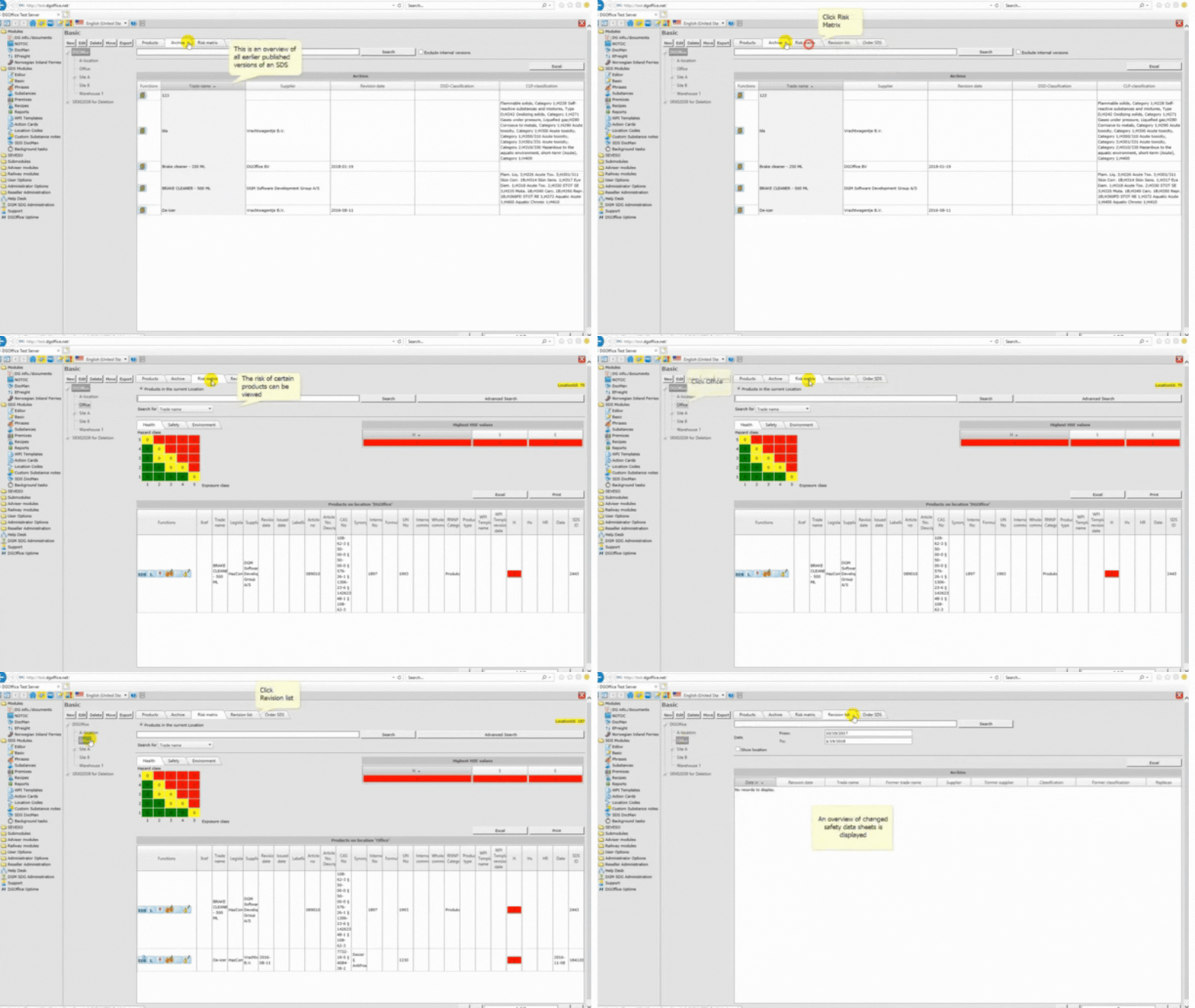
Keeping this information together also makes it easier to manage changes over time. For example, the module includes an archive for storing previous SDS versions, as well as a location structure that can be used to organize information across countries, locations and departments. The module supports chemical management in line with GHS requirements and regulations such as CLP in Europe and HazCom in the United States.
And the SDS Basic Module can also be extended with additional DGOffice functionalities, depending on an organization’s needs. For example: The SDS license offers several add-on options for chemical management, while the Own Articles Module can be used to connect an organization’s own article numbers and product names to the information in DGOffice. Other extensions can add functionality for areas such as risk determination, workplace instructions, reports and Action Cards. And that brings us back to the importance of early recognition. The earlier reliable information about a chemical product is available, the better positioned an organization is to recognize its hazards and determine which requirements may apply before the product moves further through the supply chain.
From SDS to practical instructions
Sometimes, however, having the right information available is not the end of the story. Employees also need to be able to use that information in practice. An SDS contains a large amount of technical information, while during everyday work or an incident, employees may need to quickly know which actions to take.
This is where Action Cards can add another practical layer.
The DGOffice Action Cards Module can be added to the SDS Basic Module and is used to create action cards based on SDS information and occupational health and safety requirements. These cards provide employees with practical information on how to respond when working with chemicals or in case of an incident or accident.
Read more about DGOffice Action Cards Module:
Action Cards created based on your SDSs regulation- DGM-SDG
In this way, the SDS remains the foundation for reliable chemical information, while an Action Card can make relevant instructions easier to access when they are needed.
By keeping chemical information accurate, accessible and connected to the products moving through their operations, organizations can contribute to the wider effort to identify and manage dangerous goods earlier in the supply chain.
And hopefully, greater awareness and better information throughout the supply chain can help bring that 80% down and contribute to the action IATA is calling for. And the postal service can continue to serve as a smooth and reliable connection between people and businesses around the world.
Want to know how DGOffice can help you manage Safety Data Sheets and chemical information throughout your operations?
SDS Basic
Connect safety data sheets, received from suppliers or created by yourself, to your product inventory.
Read more about DGOffice SDS Basic Module:
SDS Basic module – DGM-SDG